

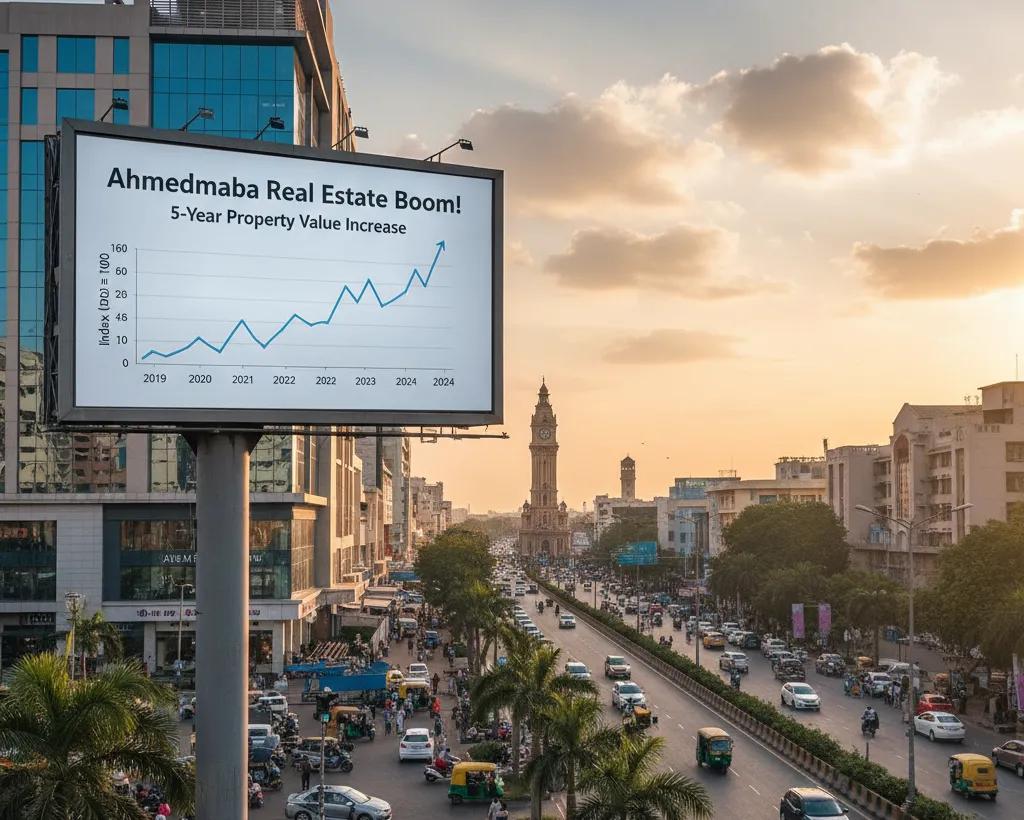
If someone bought property in Ahmedabad around 2019 or early 2020, there’s a good chance they look at today’s prices a little differently now. Not shocked exactly. But probably surprised by how steadily the market moved upward.
Because Ahmedabad’s real-estate growth over the last five years didn’t happen through one dramatic boom. It happened gradually, locality by locality, infrastructure project by infrastructure project, until buyers suddenly realized that prices across many areas no longer looked anything like they used to.
And honestly, the appreciation has been strong enough that even people who once considered Ahmedabad a “slow and stable” market have started paying closer attention.
Between 2020 and 2025, residential property prices across Ahmedabad generally appreciated somewhere between 20% and 45% depending on the area, project type, and infrastructure growth nearby.
Some locations performed even higher. Which says quite a lot about how quickly the city has evolved recently.

Ahmedabad’s Market Didn’t Explode Overnight
That’s probably important to understand first. Unlike some speculative property markets that spike aggressively in short periods, Ahmedabad’s appreciation felt more layered and infrastructure-driven.
Several things happened almost simultaneously over the last five years:
metro expansion
SG Highway growth
SP Ring Road connectivity improvements
GIFT City influence
AMC area expansion
commercial development
post-pandemic housing demand
And together, they gradually pushed residential demand across multiple localities.
The result? Average residential property pricing that once hovered around ₹3,100–₹3,800 per sq. ft. around 2019–2020 slowly moved closer toward ₹4,800–₹5,000 per sq. ft. by 2025 in many active residential zones. Some premium corridors moved far beyond that.
Post-Pandemic Buyer Behavior Changed the Market
This shift mattered more than people expected. After the pandemic, buyers started prioritizing:
larger homes
gated communities
open spaces
better residential infrastructure
long-term ownership stability
Suddenly, housing decisions became more serious.
People who were previously delaying purchases began entering the market. Families upgraded from smaller apartments. NRIs showed renewed interest. Investors returned to residential property because other asset classes felt uncertain. And Ahmedabad benefited heavily from that demand wave because the city still offered comparatively reasonable pricing compared to larger metro markets.
SG Highway Stayed One of the Strongest Growth Corridors
This part wasn’t very surprising. SG Highway has remained Ahmedabad’s primary growth corridor for years now, and the last five years only strengthened that position further.
Commercial expansion, premium residential projects, office growth, and infrastructure upgrades continued attracting buyers steadily. Areas connected to the SG Highway belt — including:
Bodakdev
Prahlad Nagar
Satellite
Thaltej
SBR-connected zones
maintained strong appreciation because demand never really slowed down there. For many buyers and investors, western Ahmedabad still represents the city’s strongest long-term residential growth zone.
Shela Changed Faster Than Many Buyers Expected
A few years ago, some buyers still considered Shela slightly “future-focused.” Now it feels much more active. Apartment prices in Shela appreciated significantly — roughly around 39–40% in several residential pockets over recent years.
The reasons are fairly clear:
newer residential projects
improving roads
gated communities
family-oriented planning
growing western Ahmedabad connectivity
At the same time, demand around: property in shela ahmedabad below 40lakh
still remains active because buyers continue searching for affordable entry points before pricing rises even further. Though honestly, finding those lower-budget opportunities has become much harder now compared to earlier years.
Satellite Continued Performing Like an Established Premium Area
Satellite wasn’t a “developing” story. It was already premium. But even mature locations appreciated strongly over the last five years because buyers still preferred areas with:
established infrastructure
central connectivity
premium residential surroundings
schools, hospitals, and commercial access already in place
Several property pockets in Satellite reportedly appreciated over 45% during this period. Which shows that even established neighborhoods continued benefiting from Ahmedabad’s broader market expansion. At the same time, searches around: property in satellite road ahmedabad below 40lakh
still appear frequently online — though realistically, options within that budget remain extremely limited in prime Satellite itself today. Most buyers at that price point usually explore older resale units or nearby connected locations instead.
Shantigram Became One of the Biggest Appreciation Stories
This area surprised a lot of people. Shantigram saw some of Ahmedabad’s strongest residential appreciation over the last five years, with certain project categories reportedly touching growth levels above 70%. That’s significant.
Large-scale township planning, infrastructure development, premium branding, and long-term investment interest all contributed to its rapid value growth. And even though the area now feels increasingly premium, searches related to: property in shantigram ahmedabad below 40lakh
still appear because buyers hope to enter developing township markets early before prices rise further. Though again, realistic availability within that range has narrowed considerably.
Ready-to-Move Properties Performed Surprisingly Well
This trend became very noticeable after 2020. Many buyers shifted toward ready-to-move apartments because:
possession risk felt lower
construction delays became less acceptable
buyers wanted immediate usability
financing felt easier to evaluate
And because demand stayed active, ready-to-move residential inventory appreciated steadily across multiple Ahmedabad localities. Especially in areas with limited unsold inventory.
Infrastructure Changed Property Values More Than Marketing
This is probably one of the biggest lessons from Ahmedabad’s last five years. Infrastructure mattered more than brochures. Metro routes, road connectivity, AMC expansion, and improved commuting patterns changed how people viewed entire locations.
Areas once considered “far” became practical. And once a locality becomes practical for daily life, demand usually follows quickly. That’s exactly what happened in several Ahmedabad residential corridors.
GIFT City Influence Extended Beyond Gandhinagar
Even though GIFT City sits outside core Ahmedabad, its influence spread across surrounding residential markets. Professionals, investors, and long-term planners began looking more seriously at:
northern Ahmedabad
SG Highway corridors
Gandhinagar-connected zones
township developments
because future employment and infrastructure growth created long-term confidence. That broader regional optimism helped support residential appreciation across multiple Ahmedabad localities.
Buyers Are Thinking Long-Term More Seriously Now
Five years ago, many buyers still viewed Ahmedabad as a relatively “safe but slow” property market. That perception shifted. Now investors and end-users increasingly see the city as:
stable
infrastructure-driven
growth-oriented
relatively balanced compared to overheated metros
And because appreciation happened steadily rather than through a sudden speculative spike, buyer confidence remained fairly healthy overall.
Affordable Housing Became Harder — But Not Impossible
This is where many first-time buyers feel the pressure. Earlier, ₹40 lakh budgets accessed far more localities comfortably.
Today, buyers searching for:
property in shantigram ahmedabad below 40lakh
property in shela ahmedabad below 40lakh
often need to:
compromise on project size
consider older resale inventory
shift slightly outward
explore under-construction opportunities
Affordable housing still exists. But appreciation definitely changed buyer expectations across the city.
The 2030 Commonwealth Games Factor
Another interesting layer now is Ahmedabad’s future infrastructure planning around the proposed 2030 Commonwealth Games preparations. Large-scale urban upgrades, transport development, and civic investment could continue supporting property appreciation across multiple zones over the coming years.
Which is one reason many investors still remain optimistic about Ahmedabad’s long-term real-estate trajectory.
Where Addressbox Helps
Tracking price appreciation manually across Ahmedabad becomes complicated very quickly because every locality behaves differently.
Platforms like Addressbox help buyers compare:
residential projects
pricing trends
locality options
budget ranges
ready-to-move and under-construction inventory
more efficiently across the city. That becomes especially useful in fast-changing markets where pricing shifts continuously from one area to another.
Final Thoughts
Ahmedabad’s property market changed quite a bit between 2020 and 2025. Some areas appreciated steadily. Others accelerated much faster than expected. But overall, the city evolved from being viewed as a relatively slow-moving residential market into one of India’s more consistent real-estate growth stories.
And unlike purely speculative markets, much of Ahmedabad’s appreciation was supported by:
infrastructure
residential demand
connectivity improvements
commercial expansion
long-term urban growth
Which is probably why confidence in the market still feels relatively strong heading into 2026. At least for now, Ahmedabad doesn’t feel like a city where growth happened accidentally. It feels planned. Gradual. And still ongoing.
FAQs
1. How much have Ahmedabad property prices increased in the last 5 years?
Residential property prices in Ahmedabad generally appreciated between 20% and 45% from 2020 to 2025 depending on location and project type.
2. Which Ahmedabad areas saw the highest appreciation?
Shantigram, Shela, Satellite, SG Highway-connected areas, and western Ahmedabad localities showed some of the strongest appreciation.
3. Why did Ahmedabad property prices rise after 2020?
Post-pandemic housing demand, infrastructure development, metro connectivity, and commercial expansion contributed heavily to rising prices.